


A Malaysian SME can receive hard-to-compare proposals when its branding brief leaves the scope open. A clear brief gives agencies the same commercial context and helps the business compare their proposed work.
Malaysia Brands' editorial guidance is to describe the business problem before asking for a new look. State who you serve, what you can prove, what stays and what changes. These details give agencies a clearer basis for defining and pricing their work.
For a growing business, the stakes are real. Mid-project is a painful time to discover that copywriting, translation, photography or editable design files were never in the fee. It is worse to choose an agency on price when the actual difference was scope. And a brief that asks an agency to promise sales results a brand identity cannot deliver builds a project that cannot succeed.
In this blog, we discuss what belongs in a brief for a Malaysian SME. We cover the commercial problem, provable positioning and targets that do not over-promise. We also discuss evidence and response fields for comparing agency proposals.
What Belongs in a Branding Brief for a Growing Malaysian SME?
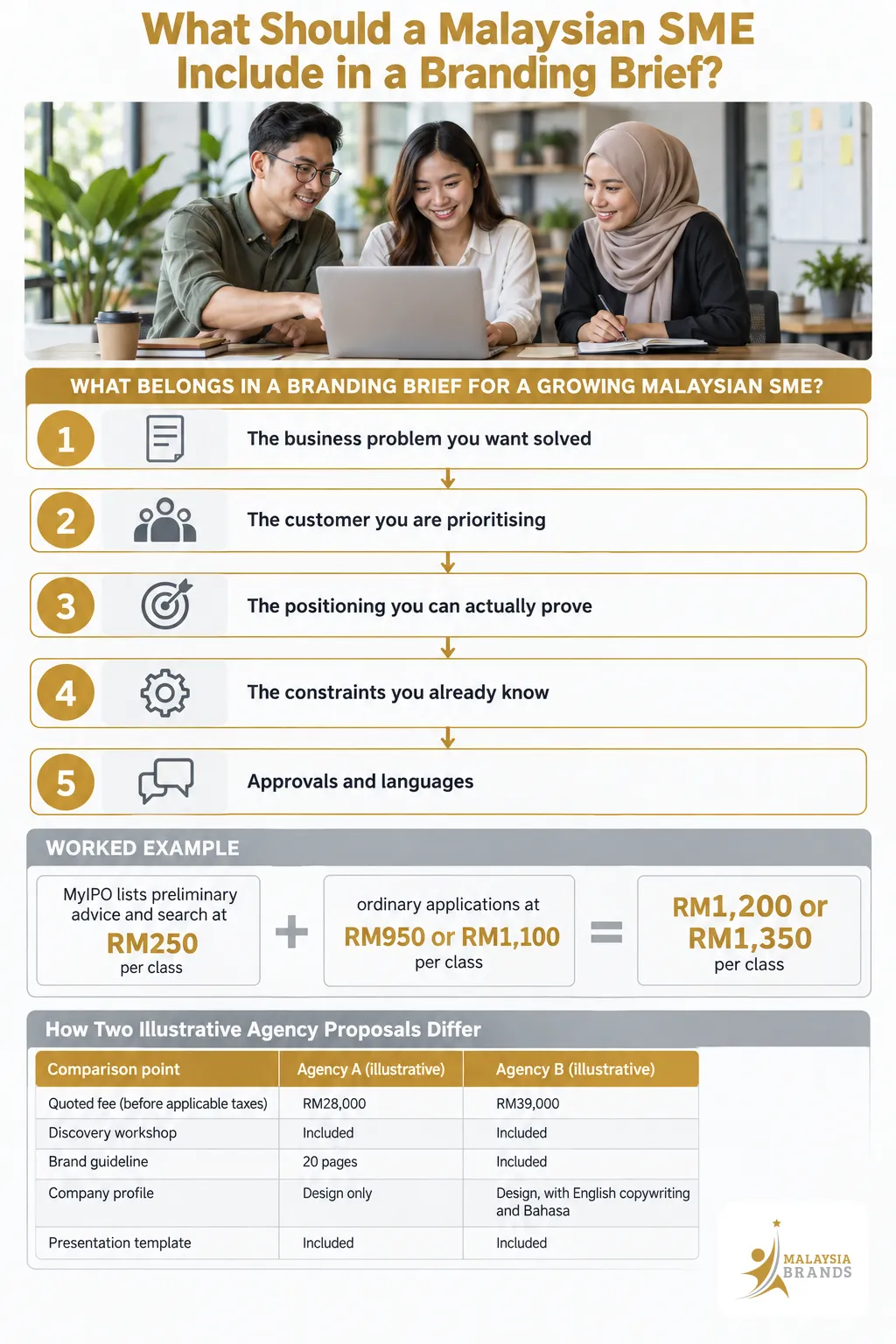
Open with the commercial problem you need solved, not with visual preferences. That gives agencies a clearer basis for their proposals. An agency can price a defined problem. It cannot price a mood. If the work includes a new name, the Intellectual Property Corporation of Malaysia (MyIPO) treats a preliminary search as separate from filing.
The sections below are Malaysia Brands' editorial guidance, not an industry formula. They are proposed recommendations awaiting practitioner review. Each section helps replace vague descriptions with facts an agency can quote against.
1. The business problem you want solved
Describe what is going wrong in commercial terms — losing quotes to equipment-only sellers, being mistaken for a reseller, or confusing buyers about what you actually deliver. Then check that you can genuinely supply the advantage you want to claim. A polished identity cannot rescue unreliable support.
2. The customer you are prioritising
Name who signs, who influences them, and what those people currently misunderstand about you. An owner-manager at a wholesaler wants different proof from a finance lead. Agencies write sharper material for one reader than for 'everyone'.
3. The positioning you can actually prove
State the position you want — implementation partner rather than hardware reseller, for instance — and list the services that make it true. The test holds for any services firm, including inventory automation. Cybersecurity ventures face the same test, as our article on business ideas for tackling cyber attacks in Malaysia explores. Every claim needs evidence you can show a prospect.
4. The constraints you already know
Give a planning budget range, a delivery window, the assets that stay (an existing company name, a website platform), and anything non-negotiable. Constraints are not weakness. They are what let an agency propose a scope you can actually buy.
5. Approvals and languages
Name the single authorised approver so decisions do not reverse mid-project. State required languages — English and Bahasa Malaysia, say — as project requirements rather than a universal legal rule, and price optional languages such as Mandarin as separate line items.
How Do You Separate Business Targets From Agency Deliverables?
Write both into the brief, but in clearly separate sections, and keep the line between them visible. Business targets describe what you want to happen in the market. Deliverables are the artefacts the agency itself produces. Blur the two and you will find yourself expecting a logo to close sales.
To make this concrete, take a purely hypothetical example — not a client of ours, and not a composite of real businesses. Imagine a private limited company, registered with the Companies Commission of Malaysia (SSM), that supplies barcode scanners, label printers and inventory-system implementation to wholesalers and small manufacturers. It has 18 employees. Its buyers are owner-managers, warehouse managers and finance leads. It wants to be seen as an implementation partner rather than a hardware reseller. That positioning question can also apply to systems integrators in Kuala Lumpur.
Suppose its brief targets more qualified enquiries and better proposal-to-order conversion. It sets a six-month review point. Those are hypothetical planning targets — not results, and not anything a branding agency can guarantee. Branding sharpens how the offer is explained. The outcome still depends on sales follow-up, pricing and operations.
On the deliverable side, the same imaginary brief requests positioning work, a clearer service structure, a refreshed visual identity, and sales materials that explain implementation and after-sales support. It also records the working assumptions. Its planning budget is RM40,000 before applicable taxes, with production costs priced separately. The delivery window is 10 weeks. The company name and website platform stay, and the managing director is the final approver. English and Bahasa Malaysia are required for the company profile and core sales presentation. Mandarin adaptation is optional and quoted as its own line.
Branding Brief Template Malaysia: Core Sections
| Section | What it states | Why it matters for comparison |
|---|---|---|
| Business problem | What is going wrong commercially, and the advantage you claim | Gives agencies a defined problem to price instead of a mood |
| Priority customer | Who signs, who influences, what they misunderstand | Aims every proposal at one reader instead of 'everyone' |
| Positioning and services | The position you want and the services that prove it | Stops claims your operations cannot support |
| Business targets | Market outcomes you want, labelled clearly as targets | Keeps outcomes separate from deliverables the agency controls |
| Deliverables | Identity, guideline, company profile, presentation, sales materials | The line every proposal can be quoted against |
| Budget and timing | Planning budget range, exclusions, delivery window | Anchors the discussion on scope you can actually buy |
| Retained assets and approvals | What stays (name, platform), the single approver | Prevents mid-project reversals and surprise vetoes |
| Languages | Required and optional languages for each deliverable | Stops anyone assuming translation is included |
What Customer Evidence Should You Attach to the Brief?
Usually one page is enough: the buyer problem, your promised answer, the evidence behind that promise, and the permission status of each item. Share the underlying material in a controlled folder with shortlisted agencies only. That lets them build on real proof instead of inventing impressive-sounding claims.
Be precise about what each piece of evidence shows. A testimonial praising responsive installation support backs a service-led position. It does not prove a quantified fall in stock discrepancies — and the evidence page should say so plainly, so nobody stretches the claim in a brochure.
1. The evidence page
Condense everything into buyer problem, promise, proof and permission status. Note what each item actually demonstrates, and where it stops. That honesty keeps the agency's copy defensible.
2. Material most SMEs already hold
Approved customer testimonials, a sales export showing how much revenue comes from existing customers, short project summaries, the current sales presentation, and a few recent lost proposals. The hypothetical SME could use testimonials, a repeat-revenue export, implementation summaries, a sales deck and lost proposals. Repeat revenue answers a different question from a retention rate; do not present one as the other.
3. Permissions to clear first
Check customer and supplier-logo permissions, and substantiate performance claims before publication. Strip unnecessary personal details from anything you share. Lost proposals may help identify whether price, scope, proof or buyer fit contributed to a loss.
How Do You Compare Branding Agency Proposals Fairly?
Give every agency the same response table — included work, optional work, exclusions and client responsibilities — and normalise their language before you judge a single price. Sending everyone the same inspirational description does not make proposals comparable. Common questions help, though agency methods and quality can still differ.
Here is a purely illustrative comparison against the RM40,000 hypothetical brief above. One agency quotes RM28,000 for a discovery workshop, a positioning statement, an identity refresh, a 20-page guideline, company-profile design and a presentation template, assuming the client supplies final copy and translations. Another quotes RM39,000 for the same outputs plus customer interviews. It also provides English copywriting and Bahasa Malaysia adaptation for the company profile. The client supplies other copy and translations. Both exclude website development, photography, printing and media spend, and both prices sit before applicable taxes. Neither figure is a market rate — both exist to show how differently two quotes can answer 'the same' ask.
Before discussing value, define the words. Does 'company profile' mean a designed document, or a researched and written sales narrative? Does 'presentation template' mean finished slides, or reusable layouts? A useful first check is what each agency assumed the client would do. Once the missing work is priced in, the cheaper quote is not automatically cheaper. If you need a shortlist, Malaysia Brands' directory of branding agencies lists local specialists.
How Two Illustrative Agency Proposals Differ
| Comparison point | Agency A (illustrative) | Agency B (illustrative) |
|---|---|---|
| Quoted fee (before applicable taxes) | RM28,000 | RM39,000 |
| Discovery workshop, positioning statement, identity refresh | Included | Included |
| Brand guideline | 20 pages | Included |
| Company profile | Design only | Design, with English copywriting and Bahasa Malaysia adaptation |
| Presentation template | Included | Included |
| Customer interviews | Not included | Included |
| Final copy and translations | Client supplies | Agency writes and adapts the company profile; client supplies other copy and translations |
| Exclusions | Website development, photography, printing, media spend | Same exclusions |
Which Terms Should You Pin Down Before Choosing an Agency?
Revisions, file handover, taxes and trademark screening can make proposals hard to compare. Write your assumptions into the request so agencies know what the package includes.
Service tax applies to taxable services provided by a taxable person in Malaysia in the course of business. Treatment depends on the service and provider.
MyIPO lists preliminary advice and search at RM250 per class and ordinary applications at RM950 or RM1,100 per class. Application fees depend on whether the pre-approved goods and services list is used. The schedule was checked on 1 November 2026. A preliminary search is not registration or comprehensive legal clearance.
1. Revisions versus change requests
Define a revision as refinement of the agreed direction. A new name, a new audience or a reversal of an approved direction is a change request. State how many creative routes and consolidated revision rounds the fee includes, and ask each agency to quote its rate for work outside that scope — as a comparison field, not as a published market tariff.
2. Files, rights and licences
Final logo vectors, editable working files and third-party asset permissions are three different things. Ask the contract to state what you receive, when, and who supplies copywriting, translation, photography and production.
3. Taxes and production costs
Ask each agency whether its quotation includes applicable tax and production costs. Check the provider and service rather than assuming every quote is taxable.
4. Trademark screening versus registration
A quick name search is not legal clearance, and it is not registration. Ask agencies who arranges screening, professional advice and filing, and what each costs.
Comparison Fields to Request from Every Agency
| Field | What to ask for | Why it matters |
|---|---|---|
| Quantities | Page and slide counts, interview numbers | Turns nouns like 'profile' into countable scope |
| Creative routes | How many directions are priced in | Extra routes often cost more than owners expect |
| Revisions | Rounds included, and the definition of a revision | Marks the boundary where change requests begin |
| Files and rights | Final vectors, editable working files, third-party licences | You may need future edits without the agency |
| Client responsibilities | Who supplies copy, translation, photography, production | The hidden half of any price gap |
| Schedule and milestones | Delivery dates and payment stages | Aligns expectations before you commit |
| Taxes and extras | Whether tax, printing and production are included | Prevents surprise costs after approval |
| Trademark steps | Who arranges screening, advice and filing, and at what fee | A search is not clearance, and clearance is not registration |
When Is a Lighter Brief the Smarter Choice?
Match the depth of the document to the size of the decision. A full competitive brief earns its keep when you are comparing agencies on a repositioning. It is unnecessary paperwork for a small adaptation — and the wrong tool entirely when the offer itself is unsettled.
1. Small adaptation jobs
A one-page task sheet handles a modest job on an established identity: supplied assets, dimensions, deadline, acceptance criteria and an agreed revision allowance. An incumbent designer who already knows the brand needs even less. The brief can be light; the deliverable should not be vague.
2. Offers and business models still unsettled
If you cannot yet say who the customer is or exactly what the offer is, do not buy a fixed-price rebrand. Scope a short discovery phase first — customer hypotheses, positioning options and a recommended production scope — then brief the production work once those decisions exist.
3. Different agency types
A strategy consultancy can sensibly propose a method before proposing finished assets; a production studio quotes artefacts. Asking both to price the same package creates superficial comparability and rewards the wrong one. Brief each provider for what it actually does.
Conclusion
A branding brief is not a longer document — it is a more comparable one. Open with the commercial problem. Name the customer you are prioritising. Claim only the position you can prove, keep business targets separate from deliverables, and attach your evidence with permissions cleared.
Then hold every agency to the same response table: included work, optional extras, exclusions and client responsibilities, with revisions, rights, taxes and trademark steps defined before you sign. That discipline is what turns three mismatched quotes into one real decision.
At Malaysia Brands, we help clients condense their evidence into a brief that agencies can price against, and we spend our days telling the stories of homegrown businesses and connecting them with local audiences. If you are preparing a repositioning — or want your brand story featured where Malaysian SMEs look for trusted names — we would love to hear from you.
Ready to Put Your Brief Together?
Tell Malaysia Brands about your SME's repositioning — or get a second pair of eyes on your brief before it goes out to agencies.
Frequently Asked Questions
Long enough to cover the core sections — problem, customer, positioning, targets, budget, constraints, evidence — and no longer. A small adaptation may need one page; a competitive repositioning justifies a structured, multi-part document.
Yes. A range with exclusions (applicable taxes, production, media spend) helps agencies propose scope you can actually buy, and keeps quotes comparable. Hiding the budget usually just produces mismatched assumptions on both sides.
No. MyIPO lists preliminary advice and search as a separate service from a registration application, with different fees under the current schedule. A search is also not legal clearance. State in your brief who handles screening, professional advice and any filing.
It depends on your buyers, not on a universal rule. Treat languages as project requirements in the brief, with optional languages such as Mandarin priced as separate line items, so every agency quotes them explicitly.
Do not commission a fixed-price rebrand yet. Scope a short discovery phase first — customer hypotheses, positioning options and a recommended production scope — then brief the production work once those decisions exist.

Malaysia Brands
Author
We are dedicated to promoting and celebrating business brands in Malaysia. We share the inspiring success stories of homegrown brands, highlighting their achievements and growth.