

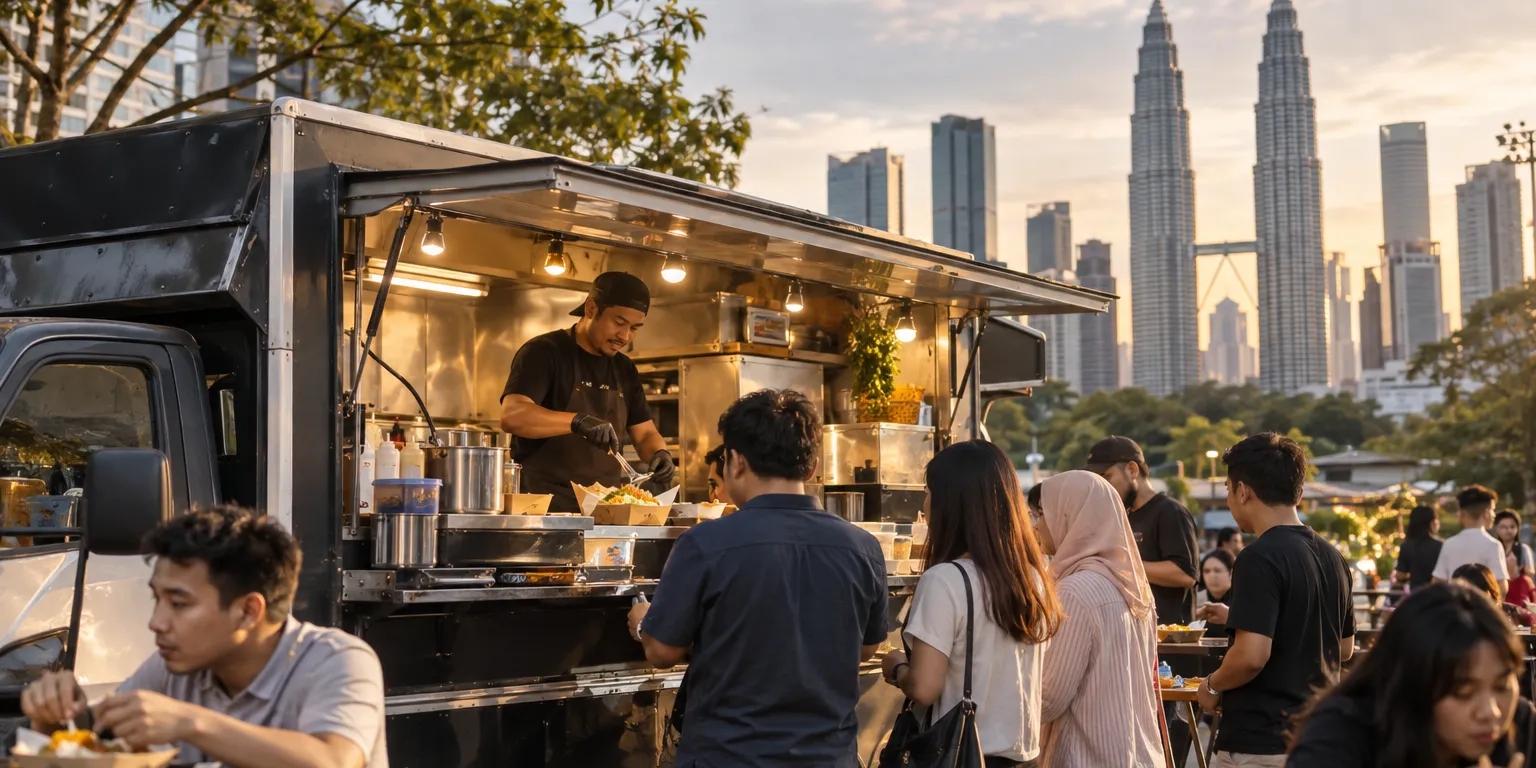
A food truck in Malaysia can cost anywhere from about RM45,000 to RM150,000 or more. Before spending that budget, a founder should complete the business registration, food handler training and typhoid vaccination that local councils check before issuing a food truck license. In Peninsular Malaysia and Labuan, sole proprietorships and partnerships register with SSM; in Sabah, check the district or municipal authority's requirements. Companies register with SSM. A fitted used van starts near RM45,000, while a new conversion can reach RM150,000 or more. That range includes the first permits. Get those wrong, and the dream stalls at the roadside.
The appeal is easy to understand. A truck lets you cook without a shoplot lease, move to wherever the crowd is, and test your menu on real customers every weekend. Night markets, festivals and campus spots have made mobile food a genuine business path, not just a hobby.
The catch is that fees and conditions differ from one council to the next, and guessing them wrong risks fines or an abrupt shutdown. A realistic budget — permits, truck, equipment and running costs — is what separates a thriving truck from a costly parked van.
In this blog, we break down what a food truck licence involves in Malaysia. We cover what each requirement costs in 2026 and which authority issues it. We also discuss every permit, price range and compliance item you should plan for before your first service.
What Does a Food Truck License in Malaysia Involve?
A food truck is a business, a food premise and a vehicle all at once. Each role has its own regulator, so plan for several approvals running in parallel rather than one single permit.
Most councils renew mobile trading licences annually, so treat renewals as a fixed yearly cost rather than a one-off.
1. Register Your Business with SSM
The Companies Commission of Malaysia (Suruhanjaya Syarikat Malaysia, or SSM) is where every legitimate business starts. Sole proprietorships and partnerships register under the Registration of Businesses Act 1956, while companies fall under the Companies Act 2016.
2. Apply for a Local Council Trading Licence
Your pihak berkuasa tempatan (PBT) — the local council — issues the licence that lets you trade in its area. Fees, zones and conditions differ from council to council, so start with the council where you plan to operate.
3. Complete Food Handler Training and Typhoid Vaccination
The Ministry of Health requires anyone who prepares or serves food to hold a food handler certificate and a valid typhoid vaccination. Accredited trainers run the courses, and most clinics administer the injection.
4. Keep the Vehicle Road-Legal
Road tax, motor insurance and a valid vehicle licence all apply to your truck. Keep copies on board — councils and event organisers routinely ask to see them.
5. Consider Halal Certification
This one is optional, but commercially important if your market includes Muslim diners. Certification falls under the Department of Islamic Development Malaysia (JAKIM) conditions.
6. Protect Your Brand with a Trademark
A catchy truck name is a genuine asset, and registering it with the Intellectual Property Corporation of Malaysia (MyIPO) costs RM950 per class under the current fee schedule. Full details are on MyIPO's trademark forms and fees page.
Which SSM Business Structure Should You Choose for a Food Truck?
SSM gives a food truck founder two common routes, and the right one depends on how you plan to grow.
A sole proprietorship is the simplest and cheapest start. Registration sits under the Registration of Businesses Act 1956, with fees set modestly in SSM's schedule. Once trading begins, you also register the business with the Inland Revenue Board (LHDN) for income tax purposes.
A private limited company (Sendirian Berhad) suits founders who want limited liability or plan to take on partners and investors. Under the Companies Act 2016 and Companies Regulations 2017, reserving a company name costs RM50 for every thirty days. The reservation lasts up to a maximum of 180 days. This fee is listed in MIDA's Cost of Doing Business guide (2025 edition).
In practice, most solo food truck founders we work with start as sole proprietors and convert to a company only once the brand grows.
Licence and Permit Checklist for a Malaysian Food Truck (2026)
| Requirement | Authority | Typical Cost (RM) | Notes |
|---|---|---|---|
| Business registration (sole proprietorship or company) | SSM | RM50 name reservation per 30 days for companies | Reservation lasts up to 180 days; sole proprietorship fees are set modestly in SSM's schedule |
| Local council trading or mobile vendor licence | Your local council (PBT) | Varies; e.g. RM20 in Seremban, RM10 in Nilai | Published Seremban processing fees, current as of 2026 |
| Food handler training and typhoid vaccination | Ministry of Health providers | Typically under RM100 combined (indicative) | Required before serving any food |
| Vehicle licence, road tax and insurance | JPJ and insurers | Varies by vehicle | Keep copies on board for council and event checks |
| Trademark registration (optional) | MyIPO | RM950 per class | Protects your truck name and logo under the current fee schedule |
What Does Your Local Council Require for a Mobile Food Business?
A food truck license sits with your local council, not a federal agency. Each council publishes its own fees, application forms and conditions, so check with the PBT for your exact area before committing to a spot.
Seremban offers a clear public example. Street vendor and mobile stall applications there carry a processing fee of RM20 in Seremban and RM10 in Nilai. These fees are published on Seremban City Council's street vendor licence page. The conditions include the following:
- Malaysian citizenship
- A minimum age of 18
- Vehicle photographs from the front, side and rear
- A copy of the vehicle grant
- The owner's permission letter if the vehicle is not personally owned.
Food and drink operators must complete the food handling course and typhoid injection beforehand.
Note the zoning limits too. Under Seremban's general policy:
- Night markets operate only in council-listed lots.
- Mobile vendors work outside the city centre and away from main roads.
- Static roadside stalls are not allowed at all.
Expect similar rules, with different numbers, in Kuala Lumpur, Penang or Johor Bahru.
Typical Startup Budget for a Malaysian Food Truck (Indicative, 2026)
| Item | Indicative Range (RM) | Notes |
|---|---|---|
| Used van or truck | 25,000 – 60,000 | Condition and kitchen space drive the price |
| New vehicle with full conversion | 80,000 – 150,000+ | Food-grade fitting adds most of the cost |
| Kitchen equipment | 10,000 – 30,000 | Griddles, fryers, refrigeration, sinks |
| Generator and wiring | 3,000 – 8,000 | Power for events without shore supply |
| Branding and vehicle wrap | 3,000 – 8,000 | Your mobile billboard |
| Initial stock and packaging | 2,000 – 5,000 | First month of ingredients and disposables |
| Licences and certifications | 300 – 1,500 | Registration, council fees, health requirements |
| Estimated total (used-truck route) | 45,000 – 115,000 | Before monthly running costs |
How Much Does the Truck and Equipment Cost?
The truck is your biggest line item, and the price range is genuinely wide. Where you land on it usually decides whether the whole project fits your savings.
The figures below are indicative market estimates for 2026, not official quotes. Prices move with vehicle condition, kitchen size and equipment quality.
1. Buy the Right Vehicle
Used vans and small trucks commonly trade between RM25,000 and RM60,000. A brand-new vehicle with a professional food-grade conversion can easily reach RM80,000 to RM150,000 or more.
2. Fit Out the Kitchen
Budget for griddles, fryers, refrigeration, sinks, water tanks and gas or electrical wiring. Equipment packages commonly land between RM10,000 and RM30,000, with a generator adding another RM3,000 to RM8,000.
3. Wrap It in Your Brand
A full vehicle wrap typically costs RM3,000 to RM8,000. It is the one spend that advertises your business at every traffic light, so it rarely goes to waste.
What Ongoing Costs and Statutory Contributions Apply Once You Operate?
Running costs decide whether a truck survives its first year, and they surprise more founders than the purchase price does.
Ingredients and packaging are obvious. Less obvious are pitch fees at night markets and events, generator fuel, maintenance, and — if you hire staff — wages plus statutory contributions.
If you employ workers, you must register them with the Social Security Organisation (PERKESO, also known as SOCSO). As an owner-operator, you can also join the Self-Employment Social Security Scheme (SKSPS) under the Self-Employment Social Security Act 2017. Coverage has been extended to the food sector, but contributions are compulsory for self-employed hawkers or traders holding the specified street or market licence or approval; the regulations took effect on 1 September 2024. The four plans, as listed in MIDA's Cost of Doing Business guide (2025 edition), are set out below.
On tax, the Sales and Service Tax (SST) has applied since 1 September 2018, replacing the old GST regime. Small street food operators generally sit outside service tax, which applies only to prescribed taxable services. Imported equipment, however, can attract sales tax — generally 10%, with 5% on certain foodstuffs and building materials. Royal Malaysian Customs publishes ongoing policy updates, so confirm current rates before importing kitchen kit.
Monthly Running Costs to Plan For (Indicative)
| Item | Indicative Range (RM/month) | Notes |
|---|---|---|
| Ingredients and packaging | 2,000 – 6,000 | Scales with your menu and covers |
| Pitch fees at night markets and events | 300 – 1,500 | Varies by location and event organiser |
| Fuel and generator costs | 400 – 1,200 | Higher with daily trading |
| Staff wages (per worker) | 1,700+ | At least the prevailing minimum wage, plus PERKESO contributions |
| Maintenance and repairs | 200 – 600 | Vehicles and kitchen equipment both wear |
Is a Food Truck the Right Business Idea for You?
A truck suits founders who love cooking but dislike landlords. Before you commit, it is worth weighing the food truck business in Malaysia against other ventures we have covered.
If your strength is storytelling rather than sautéing, our guide on a business idea for content marketing in Malaysia may fit you better. If you prefer numbers and compliance work, our article on business ideas for tax practitioner in Malaysia explores that route in detail.
The honest test is simple. The food truck business in Malaysia rewards people who love food, accept weekend and evening work, and can juggle heat, weather and cashflow at the same time. If that sounds like you, the permits are worth every ringgit.
SOCSO Self-Employment Scheme (SKSPS) Contribution Plans
| Plan | Insured Monthly Income (RM) | Monthly Contribution (RM) | Annual Contribution (RM) |
|---|---|---|---|
| Plan 1 | 1,050 | 13.10 | 157.20 |
| Plan 2 | 1,550 | 19.40 | 232.80 |
| Plan 3 | 2,950 | 36.90 | 442.80 |
| Plan 4 | 3,950 | 49.40 | 592.80 |
Where Can You Promote Your Food Truck Once It Is Licensed?
A licence puts you on the road. Marketing puts queues outside your window, and it should start the week you get approved.
In practice, the busiest trucks we see do three things well:
- Post consistently on social media — Malaysians find their next meal through Instagram and TikTok, so share your location and menu daily.
- Book recurring pitches — night markets, office blocks and campus spots reward the trucks that show up reliably.
- Get listed where locals search — a directory profile and press features build the credibility a brand-new business cannot buy.
Malaysia Brands exists for exactly this. We feature homegrown companies in our business directory, SME success stories and Best-in-Malaysia guides. If you would like your truck featured once it is licensed, reach us through our contact page.
Conclusion
To recap: a Malaysian food truck needs SSM registration, a local council licence, food handler training, a typhoid vaccination and a road-legal vehicle. Budget roughly RM45,000 to RM150,000 or more for the truck and fit-out, including RM300 to RM1,500 for licences and certifications. Those figures vary by council, vehicle and menu.
Beyond the permits, plan your monthly costs honestly, register your staff with PERKESO, and market your truck consistently from day one. The founders who treat the paperwork as a checklist, not an obstacle, are the ones still trading in year three.
At Malaysia Brands, we help homegrown businesses get seen. List your food truck in our directory, share your story with our readers, and let our Best-in-Malaysia guides put your brand in front of local customers. We would love to follow your journey from first permit to full carpark.
Ready to Put Your Food Truck on the Map?
Tell us about your food truck brand and get featured where Malaysian customers are already searching. Share your story with Malaysia Brands today.
Frequently Asked Questions
There is no single national fee. SSM registration and food handler training are modest, typically a few hundred ringgit combined, while your council licence varies by area. In Seremban, the published processing fee is RM20, or RM10 in Nilai, as of 2026 — most councils set similarly modest charges.
Yes. The Ministry of Health requires food handlers to complete an accredited training course and a typhoid vaccination before preparing or serving food. Councils check this before approving mobile food licences.
Most council vendor licences, Seremban's included, require Malaysian citizenship. Foreign investors can register companies with SSM, but street-level vendor permits are generally reserved for locals. Confirm with the relevant council before investing.
Small street food operators generally fall outside service tax, which applies only to prescribed taxable services. However, imported kitchen equipment can attract sales tax, generally at 10% with 5% on certain items. Check with Royal Malaysian Customs for current rates.
Usually, yes. You avoid a long shoplot lease and expensive renovation, though pitch fees, generator fuel and vehicle maintenance replace part of that spend. A used-truck route can start from around RM45,000 to RM60,000 all-in.

Malaysia Brands
Author
We are dedicated to promoting and celebrating business brands in Malaysia. We share the inspiring success stories of homegrown brands, highlighting their achievements and growth.