


Choosing a digital marketing agency in Malaysia often starts from the wrong end: cost per lead is compared before lead quality is even defined.
LHDN applies a reduced SME tax rate when a business meets its capital and sales conditions. Its SME page, current as of 2026, sets those conditions at paid-up capital not exceeding RM2.5 million and annual sales not exceeding RM50 million. The rate applies to taxable income up to RM600,000. Yet the marketing spend that supports that chargeable income is often reviewed far less carefully than the tax return. That creates a costly blind spot for Malaysian small and medium enterprises.
Before you compare agency pitches, check that a vendor is properly registered with the Companies Commission of Malaysia (SSM). Use SSM’s corporate-information portals for basic company verification; EzBiz applies only to businesses registered under the Registration of Businesses Act 1956 in Peninsular Malaysia and the Federal Territory. It does not tell you whether the agency can deliver qualified leads. The checks below reflect our team's professional judgement from reviewing agency proposals and lead definitions. They are not a published methodology or a universal industry standard.
This guide explains how to define a qualified lead, what evidence to request, which red flags to test, and how to keep an agency accountable after launch. In this blog, we discuss each step using the questions a careful buyer should ask before signing a Malaysian digital marketing agreement.
What Does the Term 'Qualified Leads for SMEs Malaysia' Mean?
Start by writing a definition before any campaign launches; otherwise the agency and your sales team will count different things.
A lead is only qualified if your business has agreed what qualification means. For qualified leads for SMEs in Malaysia, use a written definition before the campaign begins.
A useful split, proposed here as good practice rather than an industry standard, separates contactable marketing-qualified leads from sales-qualified leads that have confirmed a need and accepted a sales conversation.
This distinction is not automatically used by every Malaysian agency, and each business should set its own criteria. The point is to replace a vague promise with a shared record. Although LHDN's SME tax guidance uses capital and sales conditions, lead qualification remains a business decision.
1. Contactable and permissioned
Record whether the phone number and email are valid. Record permission to contact the person and whether the record is a duplicate, vendor, job applicant or current customer.
2. Matches your ideal customer profile
Check target geography, sector, company size, decision-making role, stated problem, estimated budget and buying timeframe before anyone calls the lead a fit.
3. Sales-ready or has a closed outcome
A marketing-qualified lead meets contact and fit tests. A sales-qualified lead should also confirm a relevant need and accept a sales conversation; record meeting, proposal and win or loss.
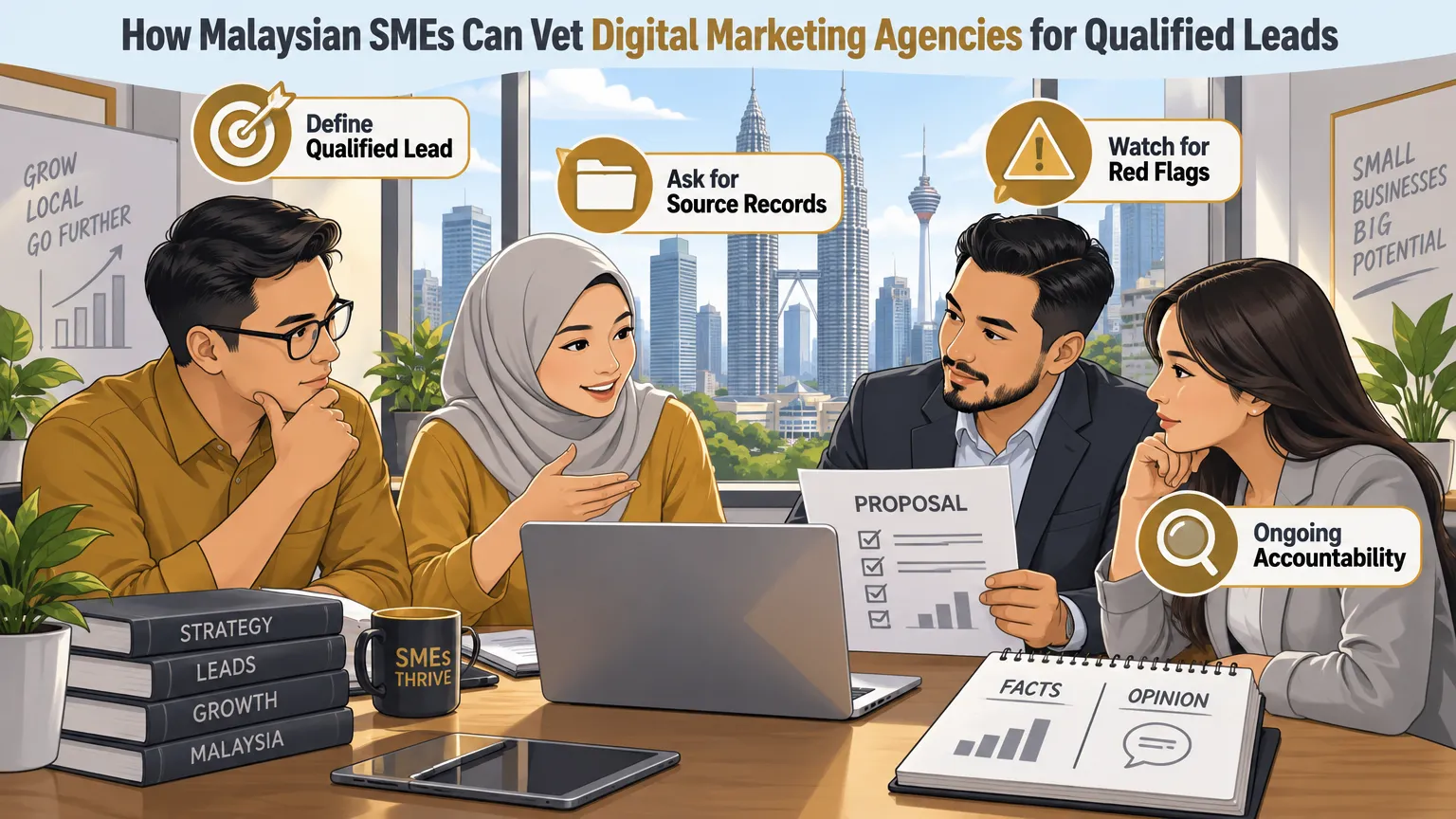
LHDN applies a reduced SME tax rate when a business meets its capital and s…
What Evidence Should You Ask a Digital Marketing Agency to Show?
Ask for records that connect campaign source data to your customer records (CRM) and sales outcomes, not just static screenshots.
Agencies commonly present dashboards, logo walls and testimonials, but these are supporting material. They do not prove that leads moved from a source campaign through your sales process.
Proposed evidence requests can include read-only access to advertising and analytics platforms. Ask for dated CRM exports and lead IDs matched across systems. References can be contacted independently through a company address or switchboard. These are requests a buyer may make; no agency is required to provide every item in every engagement.
1. Read-only platform access
A live or sandbox dashboard lets you inspect spend, source and volume without relying on an edited presentation.
2. Dated CRM or sales exports
Ask for lead IDs, source details, stage changes, meeting outcomes, proposals and wins. A static marketing list cannot show whether sales followed up.
3. Lead ID matching
Sample a few records from the agency report and trace them into the CRM. If the same ID means different things in different systems, ask why.
4. Independently contacted client references
Contact references through a company switchboard or corporate address. Ask about the agency's role, reporting quality and relevant outcomes, not general satisfaction.
A Qualified-Lead Definition Template for Malaysian SMEs
| Qualification stage | What it captures | Why it matters to sales |
|---|---|---|
| Contactable and permissioned | Valid phone and email, source, permission, duplicate or job-applicant flag | Prevents spam and ineligible records from inflating lead counts |
| Business fit | Geography, sector, company size, role, problem, budget and timeframe | Shows whether the lead matches the customer you can actually serve |
| Sales-qualified or closed | Confirmed need, accepted conversation, meeting, proposal, win or loss | Connects marketing work to revenue outcomes instead of raw enquiries |
What Are the Most Common Red Flags in Agency Lead Claims?
The clearest red flag is a percentage claim without a baseline, period, media spend or sales outcome.
Malaysian buyers often accept the term qualified lead without checking what the agency counted. The safest approach is to treat any claim as unverified until the source data can be inspected.
The following patterns usually signal that a pitch is stronger than its evidence.
1. Undefined qualified lead
If the proposal says form fills are qualified leads but does not define fit, authority, need or timeframe, ask for the written definition.
2. Growth claims without a baseline
A claim that leads increased by a large multiple means little without the starting number, the time period, the spend and whether the output was sales or traffic.
3. Testimonials standing in for outcome data
A testimonial can be genuine and still say nothing about lead quality. Keep client opinion separate from campaign and sales records.
4. Undisclosed commercial relationships
Ask whether a placement, affiliate payment or referral fee influenced the recommendation. Disclosure belongs outside the scoring decision.
What Agency Evidence Can and Cannot Verify
| Evidence request | What it can reasonably verify | What it cannot verify |
|---|---|---|
| Read-only platform or dashboard access | Campaign spend, source and lead volume | Whether the sales team followed up or the lead fitted the business |
| Dated customer relationship management or sales exports | Lead stage, proposals, wins and loss reasons | Whether the phone number still worked at first contact |
| Screenshots, logo walls and testimonials | That campaigns existed and some clients were satisfied | Lead quality, sales outcomes or the claims behind the logo |
| Independent client references | Reported role, reporting quality and relevant outcomes | Every claim in a proposal or every client relationship |
How Should You Compare Agency Proposals Without Overpaying for Hype?
Separate what is directly verifiable from what is client opinion and what is unverified marketing language.
A proposal often mixes these three things on one page. One practical approach is to build a simple worksheet that classifies every claim before you shortlist.
You do not need a formal scorecard. You need consistency: the same lead definition, the same evidence tests and the same follow-up questions for every agency.
To choose a digital marketing agency in Malaysia, compare only the rows you can check. For qualified leads for Malaysian SMEs, ask what would change the recommendation if material facts shifted.
1. Normalise each proposal against the same lead definition
Ask every agency to map its promised output to your contact, fit and sales-qualified stages. Otherwise you are comparing different products.
2. Split verified facts from attributed opinion
Label each claim as verifiable campaign data, a client's opinion, or an unverified statement. Only the first group should carry weight in a shortlist.
3. Ask what would trigger a revision
Find out whether the agency would update or remove a recommendation if reporting became unavailable, ownership changed or the delivery team shifted.
A Proposal Evidence Separation Worksheet for SMEs
| Proposal statement | How to classify it | Question to ask |
|---|---|---|
| We delivered a high volume of qualified leads each month | Unverified claim until source data is supplied | Where is the lead definition and the dated customer relationship management export? |
| A client said we were responsive | Attributed client opinion, not outcome proof | May we contact that client through a company switchboard? |
| Our dashboard shows a strong enquiry volume | Verifiable if read-only access reconciles | Can we match lead IDs to sales stages and outcomes? |
What Ongoing Checks Keep a Lead-Generation Agency Accountable?
After launch, verify that sales teams contacted the leads and record why leads were disqualified, lost or converted.
Accountability does not end at the proposal stage. The most useful review happens after handover, when the agency's promised leads meet your sales process.
Compare results by source and campaign, not only in aggregate, and reconcile a sample of sales notes with the dashboard. A campaign can look efficient at the top of the funnel while failing the business-fit test downstream.
1. Match lead IDs to the sales log
Check that each agency-supplied lead ID appears in your sales records with a handover time, contact attempts and a clear outcome.
2. Track disqualification reasons by source
Record why a lead was disqualified, lost or converted. Separate causes such as wrong market, job enquiry, duplicate or invalid contact details.
3. Set review triggers for material changes
Decide in advance what would restart your evidence review: unavailable reporting, repeated data mismatches, ownership change or a change in the team actually delivering the work.
Conclusion
The decision comes down to one question: can the agency show a straight line from campaign source to qualified lead to sales outcome? A written lead definition, evidence requests that link platform data to sales records, and a short red-flag checklist protect your marketing budget better than a polished proposal alone.
Basic corporate verification through SSM and awareness of your own tax position are starting points, not the full due diligence. The real test is whether an agency can demonstrate downstream quality rather than only top-of-funnel activity.
[Malaysia Brands](https://www.malaysiabrands.com.my/) helps local businesses build visibility and credibility through curated Best in Malaysia guides and business content. If you would like help connecting with a business audience, you can [contact the Malaysia Brands team](https://www.malaysiabrands.com.my/contact-us/). You may also find our related [Top 10 Best Accounting Services in Malaysia](https://www.malaysiabrands.com.my/best-in-malaysia/top-10-best-accounting-services-in-malaysia) guide useful. It can support the financial side of your due diligence.
Get help choosing accountable partners in Malaysia
Ask Malaysia Brands about business visibility and the practical checks behind a trustworthy agency shortlist.
Frequently Asked Questions
A qualified lead should pass agreed tests for valid contact details, business fit, confirmed need and sales acceptance. This definition should be written before any campaign begins.
Screenshots can show that a campaign existed, but they do not prove lead quality or sales outcomes. Ask for dated CRM exports and read-only platform access instead.
Check the agency through SSM's corporate-information service for its entity type, such as a Company Profile for a company or a Business Profile for a registered business. Then ask for traceable campaign records and independently contacted client references.
Ask about the agency's actual role, reporting quality and relevant outcomes. Contact the reference through a company switchboard or corporate address rather than a personal mobile number.
No, Malaysia Brands does not make direct digital marketing agency recommendations. It publishes curated business guides and content. Any recommendation should be assessed against verifiable evidence, and paid or referral relationships should be disclosed separately.

Malaysia Brands
Author
We are dedicated to promoting and celebrating business brands in Malaysia. We share the inspiring success stories of homegrown brands, highlighting their achievements and growth.