


Your new company name is only as strong as the weakest record that still shows the old one. That is why a Malaysia company name change checklist matters more than the launch itself. Customers, banks and buyers each check different places, and any one can contradict the rest.
In practice, Malaysian SMEs rebrand in three very different ways. Some change only a logo. Some adopt a fresh trading name while the legal entity stays the same. Others legally change the registered name with the Companies Commission of Malaysia (SSM). Each route leaves a different trail of records behind it.
Conflicting names do more than confuse. Payment transfers get questioned, online verifications fail, and procurement teams pause deals when the SSM record, the Google listing and the bank account appear to describe different companies. Reputable directories also hesitate to amend a listing without documentary evidence, which slows everything further.
This guide explains how to classify your rebrand. It then sets out the order for updating records from SSM to Google Business Profile. You will also find an evidence pack that makes every amendment easier. In this blog, we discuss a practical sequence for updating Malaysian business listings after a rebrand, together with the statutory duties that sit behind it.
Prepare the right records before the public relaunch.
What Belongs on a Malaysia Company Name Change Checklist First?
Classification comes before any amendment. Before you change a single record, decide which of three lanes your rebrand sits in, because the records that must change differ completely.
We offer this as a practical editorial framework rather than a legal classification. Where your situation is unusual, a company secretary should confirm the edges before you act.
1. A Visual Refresh Keeps the Legal Name
If only the logo, colours, strapline or packaging changed, treat it as a visual refresh. Update the artwork, profile images, signage and media kits, and leave the SSM record, bank accounts, tax files, contracts and legal-name fields untouched.
This shortcut applies only where the registered name, trading name, entity, address and licences are genuinely unchanged. A new logo may still justify a fresh trade-mark application with MyIPO, the national intellectual property office, but it does not change the company's identity.
2. A New Trading Brand, Same Legal Entity
Many Malaysian companies adopt a customer-facing brand while remaining the same legal entity. Update the website, Google Business Profile, social accounts, directories and customer material, but keep disclosing the exact registered name and registration number where the Companies Act 2016 requires it.
A common example is wording such as 'New Brand is operated by ABC Sdn. Bhd. [registration number]'. Treat that as an illustration, not prescribed statutory wording, and have a licensed company secretary confirm the final format.
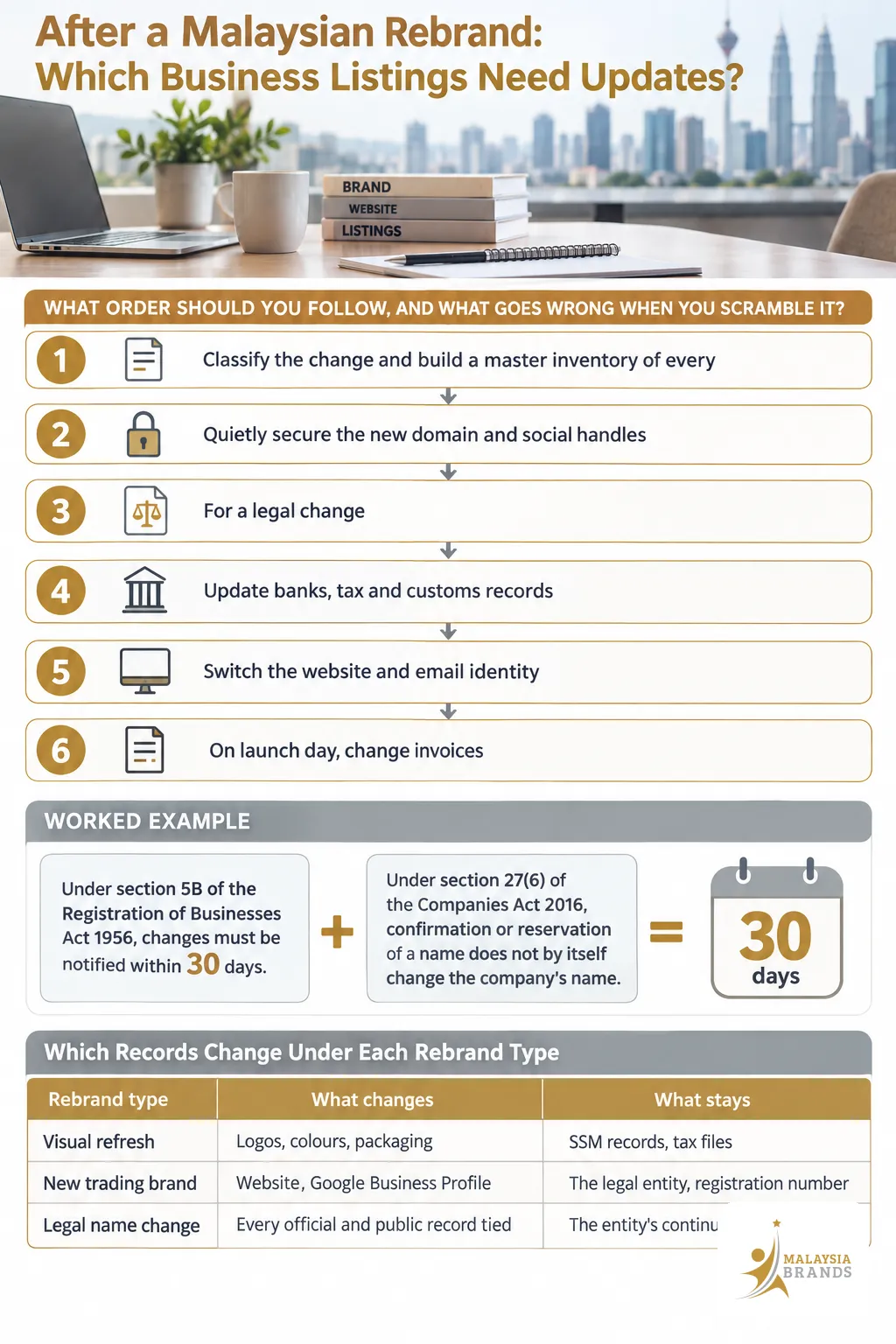
Sole proprietorships and partnerships registered with SSM must also keep their particulars current. Under section 5B of the Registration of Businesses Act 1956, changes must be notified within 30 days.
3. A Legal Company-Name Change Touches Everything
When the company legally changes its registered name through SSM, every official record tied to the company must be reconciled. That includes tax, payroll, banking, licences, contracts, invoices, payment gateways and public listings. The sections below work through that list in order.
How Does a Legal Company-Name Change Take Effect at SSM?
The change takes effect only when the Registrar issues the notice of registration of the new name, and not a day earlier. That single distinction drives the whole sequence.
First, an available or reserved name is not yet a change. Under section 27(6) of the Companies Act 2016, confirmation or reservation of a name does not by itself change the company's name. You can check your proposed name's availability and reserve it online through SSM4U's Corporate Registry System (CRS). Reservation costs RM50 for every thirty days, up to a maximum of 180 days, at the time of writing.
Second, the company passes a special resolution and lodges notice of the resolution and the name change with the Registrar within 30 days, as section 28 requires. The prescribed fee for a change of name under section 28 is RM100 in SSM's published fee schedule at the time of writing.
Third, disclosure duties follow. Under section 30, companies governed by the Companies Act 2016 must show their registered name and registration number here:
- At the registered office, business locations and places where books are kept.
- On the website, invoices, official publications and other business documentation.
Section 30(4) adds that the former name must appear beneath the present name in those disclosures for at least 12 months from the date of change. That duty spans the full list of disclosures in section 30(2), not websites alone.
Section 28(5) and (6) confirm the company's rights and obligations continue as before. That is continuity of law, not an exemption from updating contracts, bank mandates, licences and platform accounts, whose own terms may still require action.
Filing routes and documents vary by company, so ask a licensed company secretary to confirm the sequence for yours. If you do not yet have one, our guide to company secretary services in Kuala Lumpur is a starting point. Malaysia Brands is a media portal, not a corporate secretarial practice, so treat the statutory points here as a reference for that conversation.
Which Records Change Under Each Rebrand Type
| Rebrand type | What changes | What stays |
|---|---|---|
| Visual refresh | Logos, colours, packaging, signage, profile images, media kits | SSM records, tax files, bank accounts, contracts, legal-name fields |
| New trading brand | Website, Google Business Profile, social accounts, directories, customer material | The legal entity, registration number, contracts and statutory disclosures |
| Legal name change | Every official and public record tied to the company | The entity's continuity of rights and obligations under the Companies Act 2016 |
Which Official Records Must Be Updated After the Name Change?
Start with the records that carry legal weight, then move outward. In our editorial work with rebranding brands, the ones that cause the most friction when missed are tax, payroll and banking records. Each authority sets its own process, so treat this as a checklist prompt rather than a universal rule.
1. Tax Records with HASiL
The Inland Revenue Board of Malaysia (HASiL, or LHDN) handles company-name updates through its Customer Feedback Form and MyTax portal. Submit the request together with the relevant SSM change-of-name documents and your latest accounting period. Portal workflows change, so check the current process when you file.
2. Employer Records with EPF
The Employees Provident Fund (EPF or KWSP) expects employers to notify a name or status change within 21 days. Confirm the applicable employer form and supporting evidence for your entity before filing. If you run payroll through HRMS software in Malaysia, update the employer name there too, so EPF and PERKESO submissions match.
3. Employer Records with PERKESO
The Social Security Organisation (PERKESO) lets employers update a company name and upload supporting documents through its employer services. Check the live process and any entity-specific requirements before you begin, and do not assume a fixed approval timeline.
4. Banks, Insurers and Payment Providers
Bank mandates, beneficiary names and payment-gateway records should be reconciled quickly. Customers hesitate when the account they are paying still carries a former name, and that doubt surfaces repeatedly in rebrand amendments. Each provider sets its own notice and evidence requirements.
5. Licences, Customs, SST and Contracts
Sector licences, customs registrations, Sales and Service Tax (SST) registrations, insurance policies and supplier contracts may each carry notification rules. Some regulators require approval before a new name is used in regulated materials. Review each one individually rather than assuming one letter covers all.
How Do You Update Your Website, Invoices and Google Business Profile?
Treat it as one coordinated launch, and only after the SSM change has taken effect. The goal is simple: on launch day, every customer-facing surface tells the same story at the same time.
Prepare the assets earlier, then switch the public legal name once the Registrar's notice is in hand. That is a recommended operational sequence, not an SSM-mandated publication order. For most customers, the first sign of a rebrand is the Google Business Profile listing in Malaysia, so it deserves particular care.
1. Website, Domain and Email Identity
Switch the name across the site, publish a short old-name/new-name explanation, and place permanent redirects on the former domain. The footer should carry the registered name and registration number, as section 30 requires.
Update email signatures and every system that sends mail under the company name. If the refresh includes new imagery, our picks of corporate photographers in Kuala Lumpur are worth a look while the brand assets are being updated.
2. Invoices, Quotations and Official Documents
Change the company name on invoice and website templates in Malaysia together, on the same day. Invoices and quotations must show the registered name and registration number, with the former name beneath it for at least 12 months. Miss this and you hand auditors and customers a mismatch.
3. Google Business Profile and Social Accounts
Google Business Profile Help guidance is clear: the profile name should accurately reflect the real-world name across signage, website and stationery. A name change on a verified profile may trigger reverification, and Google may review or reject edits.
Where the change is a significant shift of identity, Google may instead require the former profile to be marked closed and a new profile created. Apply its current eligibility criteria to your case, and do not assume reviews or profile history carry over. Update core social accounts the same day.
Official Records to Update After a Legal Name Change
| Record | Authority or provider | What to prepare |
|---|---|---|
| Company name and profile | SSM | Registrar's notice of the new name, current company profile |
| Tax records | HASiL (LHDN) | Customer Feedback Form or MyTax submission with SSM change-of-name documents |
| Employer records | EPF (KWSP) | Employer update form with supporting evidence, notified within 21 days |
| Employer records | PERKESO | Company-name update with uploaded supporting documents |
| Banking and payments | Banks, insurers, payment gateways | Board authority, updated mandates and beneficiary details |
| Licences and contracts | Regulators, suppliers, customers | Notice and evidence per each body's or contract's own requirements |
What Order Should You Follow, and What Goes Wrong When You Scramble It?
Work from documents outward to publicity. The sequence below reflects how we approach rebrand handovers editorially, and you should adjust it to your own licences and contracts.
- Classify the change and build a master inventory of every touchpoint that carries the name.
- Quietly secure the new domain and social handles before announcing anything.
- For a legal change, complete the SSM process and obtain the Registrar's notice.
- Update banks, tax and customs records, payroll agencies, insurers, licences, contracts and payment providers.
- Switch the website and email identity, publish the old-name/new-name page and set permanent redirects.
- On launch day, change invoices, quotations, email signatures, the Google Business Profile and core social accounts.
- Update authoritative directories such as Malaysia Brands, then work through the long tail of local citations.
- Keep checking search results for weeks afterward, because submission is not completion.
From the team's editorial perspective, two patterns can disrupt a handover. One is announcing first and documenting later. A company may change its Google listing and invoices first. Its website footer, bank beneficiary and SSM record may still show the former name. This can prompt reverification, customer questions about payment details and conflicting directory edits.
The reverse also hurts. Changing SSM while leaving the website and Google untouched makes the new name look unestablished during due diligence, even though the change is perfectly legal.
Picture a hypothetical example of the cost. A B2B industrial-services firm completes a legal name change but keeps the same registration number. A prospective buyer finds the new name in the SSM profile. Google Maps and directories retain the former name, while LinkedIn uses a shortened variation. The old name remains the bank beneficiary. The website shows the new logo without explaining the relationship.
Procurement reads these as possibly separate companies. It pauses onboarding while asking for SSM evidence, bank confirmation and a letter confirming continuity. Onboarding resumes once every touchpoint agrees. Commercial documents show the new legal name and registration number. The former name appears where required, and Google and directory listings match. The old domain redirects to a transition page. Consistency, not the change itself, is what buyers check.
Launch-Day Checklist for Customer-Facing Name Changes
| Asset | Action |
|---|---|
| Website | Switch the name, publish an old-name/new-name page, keep permanent redirects |
| Invoices and quotations | Update templates; show the registered name, registration number and former name |
| New signatures and matching domain email addresses | |
| Google Business Profile | Update the name to match signage, website and stationery |
| Social accounts | Update core handles and display names |
| Customer notices | Announce the change to customers and suppliers on the same day |
What Evidence Should You Keep for Directories and Platforms?
Keep one dated evidence pack and every amendment becomes faster. Reputable directories cannot simply take a name change on request, because editors have no way to distinguish a rebrand from an impersonation attempt.
What follows is the pack we advise brands to assemble. The exact documents any given platform requires will vary, so check each one's own process before submitting.
- The SSM notice confirming registration of the new name.
- A current SSM company profile showing the registration number and the new name.
- The special resolution and any board authority for the change.
- New letterhead and invoice templates.
- Screenshots of the website's legal disclosure, plus domain ownership records.
- Matching email addresses on the company domain.
- A simple one-line old-name/new-name statement.
- Relevant licences, bank confirmation or trade-mark records where they apply.
A board resolution supports the file, but it does not replace the Registrar's notice for a completed change. For a trading-brand change, expect directories to ask for evidence connecting the brand to the legal operator, such as the website's legal disclosure or a current invoice. For a logo-only refresh, a request from a verified domain plus production-quality artwork is normally enough.
Editorial history deserves its own decision. Old domains can redirect to a transition page, and historical articles can retain the former name with a clear 'now known as' note rather than being silently rewritten. That preserves honesty for readers and continuity for search engines.
If you would like a listing amended with us, send the evidence through our contact page and the editorial team will take it from there.
Conclusion
A rebrand succeeds when every record agrees. Classify the change first, let SSM's effective date lead the public switch, then update tax, payroll, banking and licensing records before the customer-facing launch. Keep the former name visible for the twelve months the Companies Act 2016 requires, and hold one evidence pack for every directory that asks.
Treat this Malaysia company name change checklist as a working sequence: classification, documentation, official records, then listings, with monitoring afterward rather than a one-off submission.
We help homegrown brands update their listings, tell their rebrand story clearly and stay discoverable under a new name. If your business is mid-rebrand, our editorial team is ready to help you make the switch cleanly.
Updating a Listing After Your Rebrand?
Send us your SSM evidence and listing details, and our editorial team will help reconcile your brand across Malaysia Brands.
Frequently Asked Questions
No. Under section 27(6) of the Companies Act 2016, name availability confirmation or reservation does not itself change the name. The change takes effect only when the Registrar issues the notice of registration of the new name after the company lodges its special resolution and notice within 30 days.
At least 12 months from the date of change. Section 30(4) of the Companies Act 2016 requires the former name to appear beneath the present registered name in the disclosures listed in section 30(2), which include websites, invoices and official publications.
Yes. HASiL processes company-name updates through its Customer Feedback Form and MyTax portal, with SSM change-of-name documents. EPF expects employers to notify a name or status change within 21 days, and PERKESO provides an employer update process with supporting documents.
Often, yes, but the name must match your real-world signage, website and stationery. A name change may trigger reverification, and Google may review or reject edits. A significant identity change may instead require marking the old profile closed and creating a new one, so check Google's current criteria first.
No. Under sections 28(5) and (6) of the Companies Act 2016, a change of name does not affect the company's rights or obligations. Even so, banks, insurers, licensing bodies and counterparties may still require their own updates and notices.

Malaysia Brands
Author
We are dedicated to promoting and celebrating business brands in Malaysia. We share the inspiring success stories of homegrown brands, highlighting their achievements and growth.