

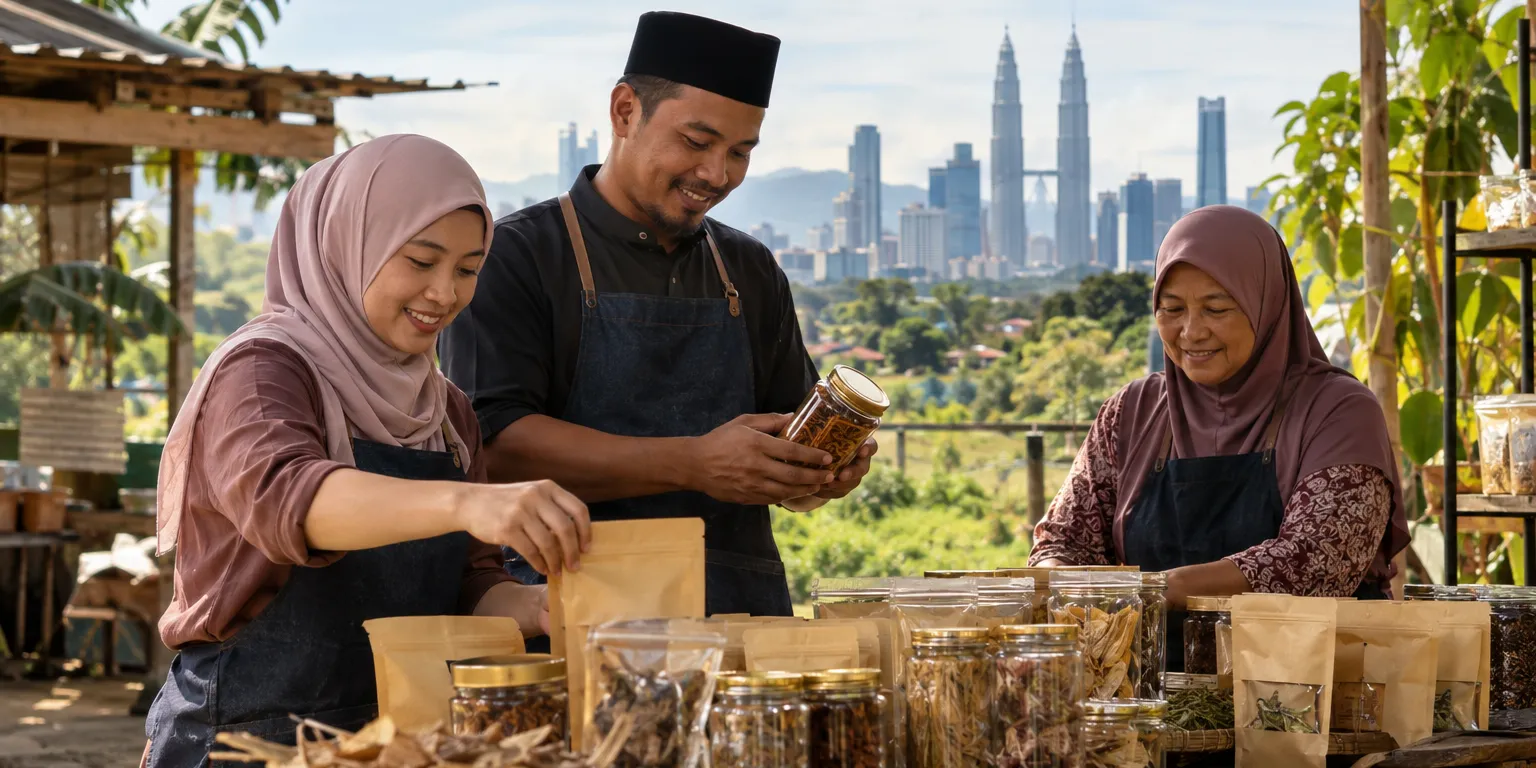
Rural funding in Malaysia now spans micro-financing, grants and 80% loan guarantees — here is what Bumiputera entrepreneurs in rural areas can apply for. If you run a roadside stall, a smallholding or a craft workshop, your postcode should not decide your working capital.
Yet most enterprises outside city limits are tiny and informally registered. Mainstream banks often read that as risk, even when the business is sound. National programmes exist precisely to close this gap.
The support on offer in 2026 is wider than most founders realise. Some eligible micro-financing carries a 0% profit rate, some grants do not require repayment, and guarantee schemes cover up to 80% of financing.
Choosing the right door the first time saves months of trial and error. In this blog, we discuss the current grants, micro-financing, soft loans and guarantee schemes that rural Bumiputera entrepreneurs can realistically pursue in 2026, plus exactly what you need to qualify.
Where Can You Find Rural Funding in Malaysia?
Rural entrepreneurs can explore MECD grants, SME Corp financing, TEKUN micro-financing, MARA programmes, SPED and government-guaranteed bank credit.
The Ministry of Entrepreneur and Cooperatives Development (MECD) sets the national entrepreneurship agenda. Its agency, SME Corporation Malaysia (SME Corp), administers programmes for micro, small and medium enterprises (MSMEs).
TEKUN Nasional and MARA concentrate on the Bumiputera community, while Syarikat Jaminan Pembiayaan Perniagaan Berhad (SJPP) provides guarantees that can help eligible businesses obtain financing when they lack collateral. The table summarises several headline schemes; check current terms and funding availability with each provider.
The Ministry of Rural and Regional Development (KKDW) still lists the Rural Economy Funding Scheme (SPED) for rural Bumiputera businesses. Its published terms show RM20,000 to RM250,000 in financing and a 3.5% annual service charge on the monthly balance. A 30% rebate is available to borrowers who apply and meet the conditions. Confirm intake availability with an implementing agency before applying.
Which Programmes Can Support Rural Bumiputera Entrepreneurs?
Five initiatives offer routes for rural founders: TEKUN, MARA and BEEP PLUS focus on Bumiputera applicants, while Mikro MADANI and some agropreneur support also serve other eligible Malaysians.
General MSME schemes serve eligible Malaysian-owned businesses that meet each programme’s conditions. Some programmes, however, prioritise Bumiputera ownership. In practice, they do the heaviest lifting in kampungs, small towns and East Malaysia.
1. TEKUN Nasional Micro-Financing
TEKUN provides shariah-compliant micro-financing for Bumiputera micro entrepreneurs, with a long rural track record in retail, agriculture and services. Confirm this year's financing limits on its official portal before applying.
2. MARA Business Financing
MARA backs Bumiputera enterprises with financing, business premises and entrepreneurship training. Rural traders and small manufacturers should check the current product list and rates on MARA's website.
3. Mikro MADANI Grants and Financing
Pengukuhan Mikro MADANI bundles the Micro Business Grant (GPM), Micro Biz Financing (MBF) and the youth-focused TUBE programme. MECD delivers this suite through SME Corp.
4. BEEP PLUS in Sabah and Sarawak
The Bumiputera Enterprise Enhancement Programme (BEEP) PLUS serves enterprises in Sabah and Sarawak. For kampung and small-town founders in East Malaysia, it is often the quickest route to formal support.
5. Agropreneur Support Under KPKM
The Ministry of Agriculture and Food Security (KPKM) runs agropreneur grants and technical aid for farmers and food producers. Intakes open by cycle, so watch its official channels for 2026 announcements.
Headline 2026 Schemes for Rural Bumiputera Entrepreneurs
| Scheme | Provider | Amount | Cost in 2026 |
|---|---|---|---|
| SFSME 2.0 | SME Corp via MIDF | RM50,000 – RM5 million | 5%–6% p.a.; 5% for 2026 approvals |
| Business Accelerator Programme (BAP) | SME Corp digital platform | Up to RM500,000 term; RM1.5 million invoice | 5% p.a. in 2026; 6%–8% from 2027 |
| PRESTIGE 2.0 | SME Corp via Funding Societies | RM500,000 – RM1 million | Term 3% p.a. with rebate up to 30%; invoice 0.5% monthly |
| Mikro MADANI (GPM and MBF) | MECD via SME Corp | Micro-scale grant and financing | Published per programme cycle |
| MSME Digital Grant Madani | BSN | Up to RM5,000 (50% of invoice) | Grant, no repayment |
| WCGS-B guarantee | SJPP | Bank loans of RM100,000 – RM3 million | 0.75% p.a. guarantee fee |
How Do SME Corp's SINAR Financing Schemes Work in 2026?
SINAR bundles three financing schemes plus one grant, with 2026 rates ranging from 0% to 6% per annum.
SME Corp introduced SINAR to help MSMEs hold cash flow steady amid economic uncertainty. Applications for the 2026 cycle opened in June and close once committed funds run out. The full line-up sits on SME Corp's official initiatives page, alongside each scheme's FAQ. Traders can also explore ideas for a buying and selling business in Malaysia when planning how to use financing.
1. Soft Financing Scheme for SMEs (SFSME 2.0)
SFSME 2.0 funds automation, digitalisation and technology adoption, from RM50,000 up to RM5 million. It charges 5% to 6% per annum on the reducing balance, at 5% for approvals granted in 2026. Malaysian Industrial Development Finance Berhad (MIDF) is the implementation partner.
2. Business Accelerator Programme (BAP)
BAP offers term financing up to RM500,000 over 36 months at 5% per annum for 2026 approvals, rising to 6%–8% from 2027. Its invoice and purchase-order line reaches RM1.5 million, which suits a buying and selling business in Malaysia that restocks often.
3. PRESTIGE 2.0 Financing Scheme
PRESTIGE 2.0 backs high-growth strategic industries with RM500,000 to RM1 million. Term financing costs 3% per annum with a rebate of up to 30%, while invoice financing costs 0.5% monthly.
4. Skala-IB Inclusive Business Grant
Skala-IB supports recognised inclusive businesses that involve eligible communities in their value chains, with capacity-development grants of up to RM200,000 per eligible company; training support is also available under SINAR. Agribusinesses and rural processors fit it naturally.
Can You Borrow Without Collateral Through a Government Guarantee?
Yes — SJPP's Bumiputera guarantee scheme covers up to 80% of a participating bank's loan to you.
Syarikat Jaminan Pembiayaan Perniagaan Berhad (SJPP) manages several Government Guarantee Schemes, including the WCGS variants, ADGS and MADANI schemes. The Bumiputera variant, WCGS-B, backs loans of RM100,000 to RM3 million for companies at least 51% Bumiputera-owned.
The guarantee fee runs at 0.75% per annum, payable in advance, while participating banks set the interest rate themselves. Published terms keep the schemes available until 31 December 2035, or until limits are fully used.
A guarantee protects the lender, not you: you remain responsible for repaying the loan in full, and participating banks may still ask for some security. With most of the loan covered, however, a bank can lean more on your cash flow than on land it would normally decline. Every variant is compared in SJPP's FAQ page.
Government Guarantee Schemes Under SJPP
| Scheme | Financing limit | Guarantee fee | Best suited to |
|---|---|---|---|
| WCGS (general) | RM100,000 – RM10 million | 1.0% p.a. | Working capital for established MSMEs |
| WCGS-B (Bumiputera) | RM100,000 – RM3 million | 0.75% p.a. | Companies at least 51% Bumiputera-owned |
| WCGS-SU (start-up) | RM50,000 – RM500,000 | 0.75% p.a. | Businesses 6 months to 2 years old |
| WCGS-X (export) | RM100,000 – RM10 million | 0.75% p.a. | MSMEs with at least 30% export turnover |
| WCGS-W (women) | RM100,000 – RM1 million | 0.75% p.a. | At least 51% Malaysian women-owned |
| ADGS (automation) | RM100,000 – RM10 million | 0.75% p.a. | Equipment and digital adoption |
What Do You Need to Qualify for These Rural Schemes?
Almost every scheme asks for the same three things: proper registration, a trading history and basic financial records.
Companies register with SSM; sole proprietors generally register with SSM in Peninsular Malaysia and Labuan, or with the relevant local authority in Sabah and Sarawak, and must obtain any required licences. Cooperatives register with the Malaysian Cooperative Commission (SKM).
The MSME Digital Grant Madani adds three tests: at least 60% Malaysian ownership, six months of operation and RM50,000 in average annual sales. Full criteria sit on BSN's MSME Digital Grant page.
Guarantee-backed loans also respect SME size caps. Non-manufacturing firms must have sales not exceeding RM20 million or no more than 75 full-time workers, and manufacturers must have sales not exceeding RM50 million or no more than 200 full-time workers. SJPP specifies a six-month to two-year operating requirement for WCGS-SU, not WCGS-B.
Documents most providers will ask for include:
- Copy of SSM registration, SKM certificate or PBT licence
- MyKad and proof of Bumiputera shareholding where required
- Bank statements for the past six months
- A simple profit-and-loss record
- Quotations for equipment, stock or digital tools
- A short business plan for larger financing
Eligibility Snapshot for 2026 Applications
| Requirement | MSME Digital Grant | SINAR financing | WCGS-B guarantee |
|---|---|---|---|
| Registration | SSM, PBT, SKM or professional body | SSM-registered MSME | SSM, LLP, PBT or statutory body |
| Ownership | At least 60% Malaysian | Open to Malaysian MSMEs | At least 51% Malaysian and 51% Bumiputera |
| Track record | At least 6 months operating | Varies by scheme | WCGS-B: not specified |
| Sales threshold | RM50,000 average annual sales | SME size limits apply | SME size limits apply |
How Can You Strengthen Your Funding Application?
Preparation beats luck: clean books, the right scheme match and a simple plan carry most applications.
Approval rarely depends on who you know. Assessors want proof that funds will be used and repaid. Five habits make rural applications genuinely competitive. For a practical start-up example, see our wedding photographer business idea in Malaysia guide; to share your own story, visit our contact page.
1. Match the Scheme to Your Stage
Micro enterprises should start with Mikro MADANI or TEKUN, while growing firms fit SFSME 2.0. Traders suit BAP's invoice line. If your venture is still an idea, our wedding photographer business idea in Malaysia guide shows how a one-person studio begins small.
2. Keep Loan-Ready Books
Simple accounting software keeps statements and profit records current between harvests and festive seasons. Lenders almost always request six months of bank records.
3. Write a One-Page Plan
State what you will buy, how it lifts income and how you will repay. Attach supplier quotes. Clarity persuades assessors faster than jargon.
4. Claim Digitalisation Grants First
The MSME Digital Grant pays up to RM5,000, or 50% of an invoice, for online tools. A visible web presence also helps lenders verify your business quickly.
5. Build Visibility Alongside Financing
Funded founders who turn local trust into export sales tend to grow fastest. Feature stories and brand directories add the credibility lenders notice, and our contact page is where those stories begin.
Conclusion
Rural Bumiputera entrepreneurs in 2026 have real breadth of choice: GPM grants and invoice financing at one end, RM5 million soft loans and 80% guarantee schemes at the other. Most applications begin with SSM registration and six months of clean records, so preparation is your best investment.
Match the scheme to your stage, quote the 2026 rates when you apply, and confirm current limits with each provider, since several lines close once committed funds run out.
Malaysia Brands exists to help local ventures like yours become visible and trusted. We share SME success stories, curate Best in Malaysia guides and connect founders with services that matter. If your rural brand deserves a bigger audience, we would love to tell your story.
Feature Your Rural Brand on Malaysia Brands
Tell us how your kampung enterprise grew. We publish SME success stories and Best in Malaysia guides for founders like you.
Frequently Asked Questions
For most rural micro businesses, the easiest options are Mikro MADANI's GPM grant and TEKUN micro-financing: GPM is a grant with no repayment, while TEKUN offers shariah-compliant micro-financing. The MSME Digital Grant Madani adds up to RM5,000 for digital tools.
For most schemes, yes. Sole proprietors can often use a local council (PBT) licence instead, while cooperatives register with the Malaysian Cooperative Commission (SKM).
Many are open to all Malaysian-owned MSMEs, including SFSME 2.0, BAP and PRESTIGE 2.0. WCGS-B, TEKUN and MARA lines carry Bumiputera criteria.
WCGS-B backs loans of RM100,000 to RM3 million for companies at least 51% Bumiputera-owned, with government guarantee cover of up to 80%, per SJPP's published terms.
No. Grants such as GPM and the MSME Digital Grant are not loans, though conditions apply to how funds are spent. Financing schemes must be repaid at their stated rates.

Malaysia Brands
Author
We are dedicated to promoting and celebrating business brands in Malaysia. We share the inspiring success stories of homegrown brands, highlighting their achievements and growth.