


Every credible entry on a Malaysian 'best' list should trace back to a live registration. Check this with the Companies Commission of Malaysia (SSM), the statutory body responsible for company incorporation and for business registration in Peninsular Malaysia and Labuan. That single check is where reading a list properly begins, because a ranking tells you who is visible, not who is verified. The same scrutiny matters when appointing a global asset trustee, because fiduciary work requires verified licensing before any assets move.
Malaysian buyers now meet providers through curated guides, awards, directories and rankings long before a first meeting. Each format answers a different question, yet they often share the same confident headline. Treating them as interchangeable evidence is the quickest way to shortlist the wrong firm.
The stakes are real for SMEs, because choosing among the best service providers in Malaysia starts with knowing what a list actually measured. A wrong hire, whether an accountant, a digital agency or a consultant, costs time and money that a small business can rarely recover. For a focused example, our 2026 guide to the top accounting firms in Malaysia for startups and small businesses walks through exactly how to shortlist.
This article explains the formats behind Malaysian best lists, the disclosures that separate genuine research from promotion, and the checks that turn a shortlist into a confident decision. In this blog, we discuss how to choose a service provider in Malaysia the way an editor reads a list before publishing it.
What Do Best Service Providers in Malaysia Lists Actually Claim?
A defensible list states the question it answers. It may cover providers an editorial team found worth considering, brands readers voted for, or websites that attracted measured traffic. A title alone does not reveal the scope, pool or comparison method. Treat the headline as a claim to unpack rather than a conclusion.
In our editorial experience, the most useful habit is asking what evidence sits behind each entry. An editorial shortlist, a reader-vote result, a sponsored placement and a traffic-based ranking support very different statements. None of them automatically equals an objective quality verdict for every buyer.
The checklist approach below reflects our professional judgement about reading lists. It is not a verified description of every Malaysian publisher's format, so use it as a lens rather than an accusation.
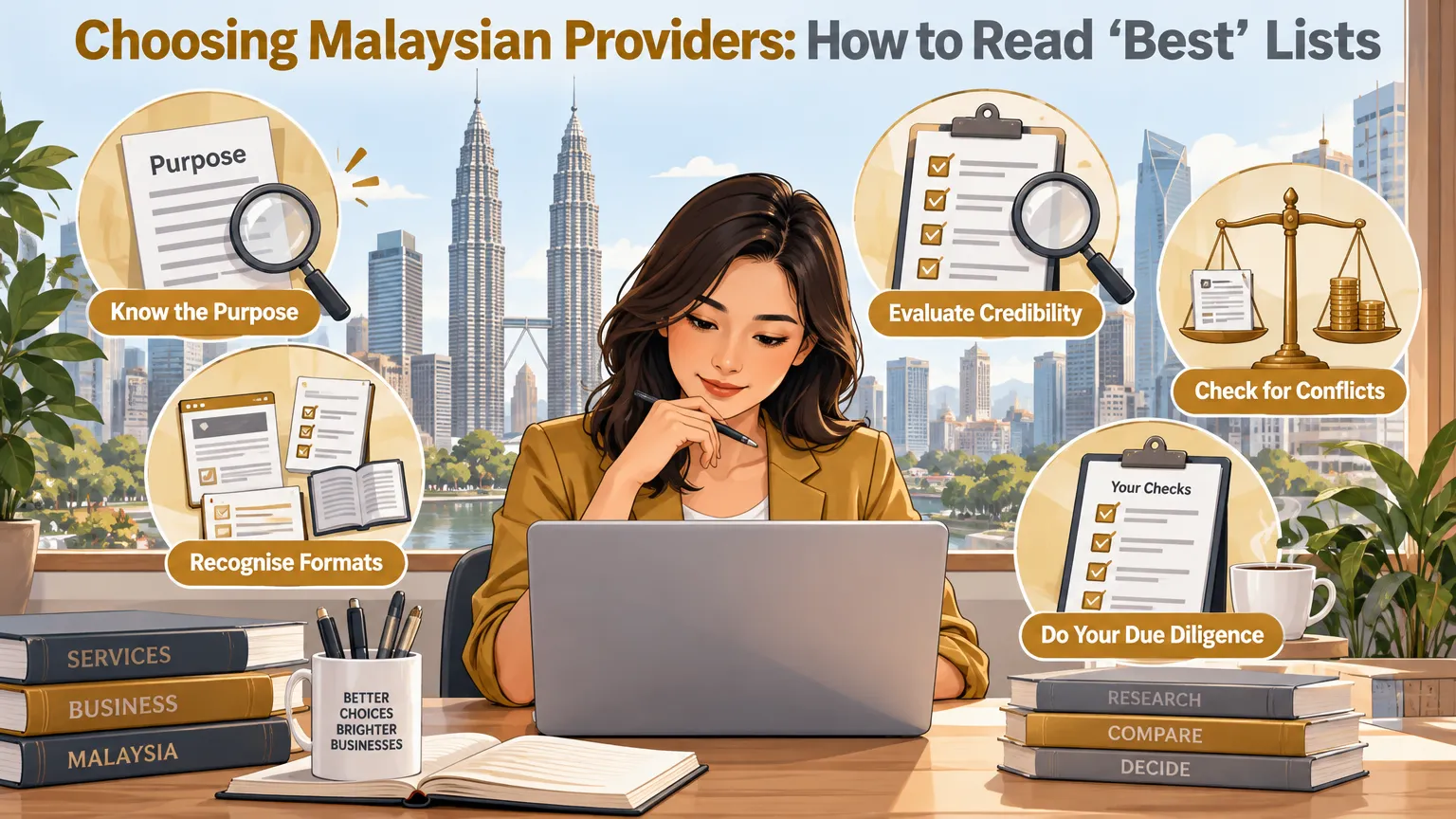
Which Formats Do Malaysia Best Lists Take?
Malaysian best lists generally fall into a handful of recognisable formats. Each format can support a specific, honest claim, and each leaves different clues on the page. These categories are illustrative examples rather than verified Malaysian-market cases, but the patterns are stable enough to guide your reading.
1. Editorial selection guides
A research team assesses candidates against stated criteria and publishes a selection that may or may not be ranked. The defensible claim is that these are useful, verified options, not necessarily the largest firms in the country. Look for a methodology note, evidence dates and language that avoids voting or ranking claims.
2. Reader-vote awards
A vote result is evidence of accepted ballots during a defined campaign, not automatically evidence of service quality. A careful publisher discloses the vote window, eligibility rules and how duplicate or automated ballots were handled, so the result can be interpreted honestly.
3. Sponsored or featured placements
A premium position on a directory page may reflect paid visibility rather than editorial merit. That is legitimate marketing when it is labelled clearly. Look for item-level labels such as Featured or Sponsored, and repeated invitations to advertise, which signal a commercial format.
4. Traffic-based rankings
Estimated web traffic can indicate measured audience activity for comparable domains during a stated period. It says little about service quality, delivery or after-sales care. The page should name the analytics source, the measurement window and which domains were excluded.
5. Review-score rankings
Some lists order businesses by public review ratings once a minimum review volume is met. The useful disclosures are the platform, the extraction date and any tie-break rule. Testimonials and awards inside a profile are usually descriptive rather than ranking inputs.
List Formats and What They Can Honestly Claim
| List format | What it can support | Page clues to look for |
|---|---|---|
| Editorial guide | These options passed a stated assessment | Methodology note, evidence dates, no ranking language |
| Reader-vote award | This brand received the most accepted votes | Vote window, eligibility rules, ballot filters |
| Featured or sponsored slot | This position was purchased | Item-level labels, calls to advertise, mixed pool |
| Traffic ranking | This domain attracted the most measured visits | Named analytics source, period, exclusions |
| Review-score list | This business rates highest among eligible reviews | Platform, extraction date, threshold, tie-break rule |
How Do You Evaluate Business Recommendations on a Malaysian List?
Once you know the format, the next step is testing whether the list gives you enough information to interpret it. In our editorial experience, four disclosures do most of the work, and their absence should lower the weight you give the page.
None of these disclosures is guaranteed to appear, and none is required by any Malaysian rule that we are aware of. Where they are missing, ask the publisher directly before acting on an inclusion.
1. Look for a stated methodology
A trustworthy guide explains how candidates were found, assessed and compared. If no method is described, you cannot tell whether entries were tested, nominated or bought, so weight the list lightly.
2. Check the research date
Evidence ages quickly. A guide verified recently is far more useful than one resting on research done years ago, especially where registrations, credentials or ownership have changed. Look for an assessment or last-verified date near each entry.
3. Ask about the candidate pool
Top only means top of something. Every list draws from a finite pool shaped by research, nominations or directory records, and article formats are often capped at a round number of entries. A good guide states its pool and eligibility rules plainly.
4. Read the ordering rule and labels
Order confuses readers more than almost anything else. A list should say whether entries are ranked, alphabetical, editorially sequenced or commercially promoted. If the page is silent on both order and commercial labels, assume nothing about position.
What Due Diligence Should You Do Beyond the List?
A well-read list narrows the field; your own checks settle the decision. For entity checks, start with the Companies Commission of Malaysia (SSM). For tax checks, start with the Inland Revenue Board of Malaysia (LHDN).
Our top 10 best accounting services in Malaysia is a starting point for this vetting. The same applies to our top 10 best digital marketing agencies in Malaysia. Inclusion is evidence worth investigating, not a substitute for buyer-specific due diligence. No list can guarantee an outcome for your particular requirement.
1. Confirm the entity is real
Ask for the full legal and trading names. Then verify the entity yourself through SSM's official information portals. For tax matters, use LHDN guidance.
2. Request a scoped quotation
Before comparing, make each provider quote the same scope: deliverables, timeline, exclusions, fees and what counts as a change. If you are vetting an accounting firm in Kuala Lumpur, its SSM record should match the name on the quotation exactly. A transparent quotation process is itself evidence about how a firm communicates.
3. Ask for relevant work and references
Request examples closest to your situation and speak to references. Marketing claims unsupported by project examples, customer evidence, official records or direct verification deserve no weight in your decision.
4. Verify credentials and registrations
For regulated services, check the relevant professional body or regulator rather than accepting a badge on a website. Awards deserve similar scrutiny, so note the issuer and the year. Inflating credentials is one of the more common ways businesses try to influence selection, which is why experienced editors record legal names and awards separately.
Reader Checklist Before Trusting a List
| Disclosure to find | Why it matters |
|---|---|
| Stated selection question | Tells you whether the list is editorial, popular or paid |
| Methodology or criteria | Shows whether candidates were compared on the same basis |
| Research or verification date | Signals whether the evidence is still current |
| Candidate pool and eligibility | Reveals what 'top' actually measured |
| Ordering rule | Prevents reading page position as a quality rank |
| Item-level commercial labels | Separates paid visibility from editorial merit |
Where Do Readers Usually Get Stuck on a Best List?
One trap worth guarding against is treating page order as a ranking when the page never says so. Order can be alphabetical, editorial or commercial, and silence on this point should make you more careful, not less.
Another assumption worth resisting is that 'top' entries were surveyed against the entire market. In practice, most lists work from a defined candidate pool with an evidence cut-off, and the number of entries often reflects an article format rather than a whole-market census.
Styling also misleads. When premium and standard directory entries look identical, a reader cannot see what was paid for. Similarly, self-supplied claims should be distinguished from facts the publisher actually checked, and narrative profiles should not be mistaken for comparative scores.
None of these traps makes a list dishonest. They simply mean the page owes you clearer disclosures, and you owe the page a slower read. For vetting at the industry level, it also helps to understand how business associations support Malaysian local brands, since credible association membership is another verifiable signal.
Buyer Checks Before Signing Any Provider
| Check | Evidence to request |
|---|---|
| Legal identity | Full legal and trading names plus SSM registration details |
| Scope and price | Written quotation covering deliverables, timeline and exclusions |
| Track record | Project examples close to your requirement and references |
| Credentials | Registration with the relevant professional body or regulator |
| Responsiveness | Reply times and clarity during the quotation stage |
Why Do Corrections and Conflict Disclosures Matter?
A publisher's handling of errors and commercial relationships tells you how accountable a list is. Look for a visible correction route, dated notes when material changes are made, and a clear statement of how paid relationships are labelled.
Conflict handling matters most when a listed business becomes a paying client of the publisher. The honest answer, in our view, is disclosure without preferential treatment, though practices vary across the industry. Treat a publisher's disclosure behaviour as a trust signal rather than a guarantee.
If you spot an error, report it. On our site, you can flag concerns through our contact page. Publishers who log, verify and answer reports show the accountability you want before trusting their recommendations.
Conclusion
Reading a Malaysian 'best' list well comes down to three moves: identify the format, test the disclosures, then run your own checks. An editorial shortlist, a vote result, a paid slot and a traffic ranking are different forms of evidence, and none of them replaces quotations, references and verified credentials.
Treat every list, including ours, as a starting point for research rather than a final verdict. The best service providers in Malaysia for your business are the ones whose scope, track record and credentials fit your specific requirement. A loud headline is not enough.
Malaysia Brands exists to make that research easier, through Best in Malaysia guides, SME success stories and a curated business directory built to give local brands visibility with credibility. Explore our guides, and if you would like your brand considered for editorial assessment, our team would be glad to hear from you.
Turn a Shortlist into a Confident Choice
Browse our Best in Malaysia guides, or submit your brand for editorial consideration. Every listing is a starting point you can verify.
Frequently Asked Questions
No. A list can only support the claim it actually tested, such as editorial selection, reader popularity or paid visibility. Use it as a shortlisting aid, and still verify scope, references and credentials yourself.
Look for item-level labels such as Featured, Sponsored or Premium listing, repeated calls to advertise, and placement that does not follow a disclosed score. If paid and standard entries look identical, ask the publisher directly.
It shows the brand received the most accepted votes during a defined campaign. Without disclosed vote rules, dates and ballot filters, it is popularity evidence rather than proof of service quality.
Confirm the legal and trading names, check the registration with SSM, verify regulated credentials with the relevant professional body, and request a scoped written quotation plus references from comparable work.
Not unless the page explains its ordering rule. Position may be alphabetical, editorial or commercial, so shortlist several entries that fit your scope and compare quotations and evidence directly.

Malaysia Brands
Author
We are dedicated to promoting and celebrating business brands in Malaysia. We share the inspiring success stories of homegrown brands, highlighting their achievements and growth.